Villa extension in Dubai: approvals, cost and timeline
A villa extension in Dubai needs a Dubai Municipality permit, a developer NOC if you live in a managed community, and a build budget of roughly AED 2,800 to AED 4,200 per square metre. This guide covers what counts as an extension, which plot rules decide the size, the approval route, and how to read a contractor quote without guessing.
Why work with ROUND TRIANGLE DECORATION CO. L.L.C
- We audit the villa quote you already hold, line by line
- Same villa scope re-priced as a clear fixed price from AED 100,000
- Itemised rates for structure, MEP, finishes and authority fees
- Written notes on what a weak quote leaves out
- One direct line for calls and WhatsApp on +971 50 786 0555
- Villa extension and villa renovation work across Dubai
What counts as a villa extension vs a modification in Dubai
An extension adds built up area or a new enclosed room outside the existing footprint. A modification changes something inside the existing walls without adding area. The two routes cost differently and are checked differently, so the label matters before any drawing is made.
Usually treated as an extension
- A ground floor room, majlis or bedroom added outward from the existing wall line
- A first floor or roof room built over an existing garage or ground floor slab
- A garage converted into habitable space with a new slab, roof and wet area
- An annex with its own entrance, kitchenette and bathroom
Usually treated as a modification
- Internal wall removal or a new internal partition
- Kitchen or bathroom refit with no change to the footprint
- Window and door replacement
- Shade structures and pergolas within your community allowance
A new enclosed room always changes the built up area on your plot, which is why it triggers a fresh structural review, a setback check and often a new DEWA load assessment. If a contractor tells you a small room needs no permit, ask for that in writing and then verify it. Unpermitted extension work in Dubai can attract fines and, in some cases, a demolition order.
Plot ratio, GFA and setback rules that decide what you can build
Three numbers on your plot decide the ceiling on your extension before price is even discussed.
Plot ratio or FAR
Most villa plots in Dubai sit between 0.5 and 1.0. A 900 m2 plot in a low density community can carry far less floor area than a similarly sized plot on a main road. Use the zoning on your own plot file, not a neighbour's finished house as a reference.
GFA already used
GFA is your existing house plus the new extension. Many villas already consume most of the allowance, which is why a first floor addition is often easier to approve than a wide ground floor push into the garden.
Setbacks
Common minimums are 3 m from the side boundary, 3 to 5 m from the rear and 5 to 6 m from the road frontage. Some communities also count boundary walls, pools and hard landscaping inside the setback. Height is capped too, usually two floors plus roof within about 9 to 11 m, and new windows must not overlook a neighbour's garden or majlis.
The approval route: Dubai Municipality, Trakhees or DDA, and the developer NOC
Your jurisdiction depends on where the plot sits. Dubai Municipality handles most villa plots. Trakhees covers the Ports, Customs and Free Zone areas. Dubai Development Authority covers DDA zones. If you live in a managed community, the developer NOC comes before the authority submission.
- Confirm jurisdiction and appoint a licensed consultant whose drawings the authority will accept.
- Apply for the developer or community NOC. Expect AED 1,000 to AED 5,000 in NOC fees plus a refundable build deposit. The design is checked against the community design code, not just the building code.
- Submit to the authority with architectural, structural and MEP drawings, plot and title deed, NOC, and valid contractor and consultant registration cards.
- Pay permit fees, roughly AED 1,000 to AED 6,000 for a typical villa extension, plus separate inspection and completion fees.
- Build with stage inspections, usually structural first, then MEP, then final.
- Collect the completion certificate. That document is what lets you correct records and, where needed, update DEWA.
What each party asks for
- Dubai Municipality: drawings, structural calculations, contractor and consultant registration, plot and title deed.
- Developer or community: NOC application, design matching the community code, contractor details, deposit.
- DEWA: load assessment when the extension adds AC, a kitchen or an electric water heater. An annex with its own entrance sometimes needs a separate meter.
The detail on NOC rejections and resubmissions is worth reading before you sign anything, and we cover it separately in our guide to villa extension approval in Dubai.

Structure stage on a live villa build: excavation, rebar and formwork before the slab pour.
What a villa extension costs in Dubai
A 60 m2 ground floor extension in Dubai typically lands between AED 2,800 and AED 4,200 per m2, so AED 168,000 to AED 252,000 before furniture and loose fittings. Authority fees sit outside that rate.
| Item | Rate per m2 | 60 m2 example |
|---|---|---|
| Structure: foundation, columns, slab, blockwork, insulation | AED 1,000 to 1,400 | AED 60,000 to 84,000 |
| MEP: electrical, plumbing, drainage, AC and ventilation | AED 550 to 800 | AED 33,000 to 48,000 |
| Finishes: plaster, tiling, doors, paint, light fittings | AED 900 to 1,400 | AED 54,000 to 84,000 |
| Fees and NOC: permit, inspections, deposit | Not per m2 | AED 8,000 to 30,000 |
Two patterns show up again and again. A first floor extension costs more than a ground floor one, often AED 3,200 to AED 4,500 per m2, because of lifting, scaffolding and propping. Finishing level then moves the number more than size does, so a 40 m2 majlis with marble, joinery and a false ceiling can beat an 80 m2 shell addition on rate. For a fuller rate breakdown by scope, see villa extension cost in Dubai, and for interior benchmarks in existing rooms, villa renovation cost per square foot in Dubai.

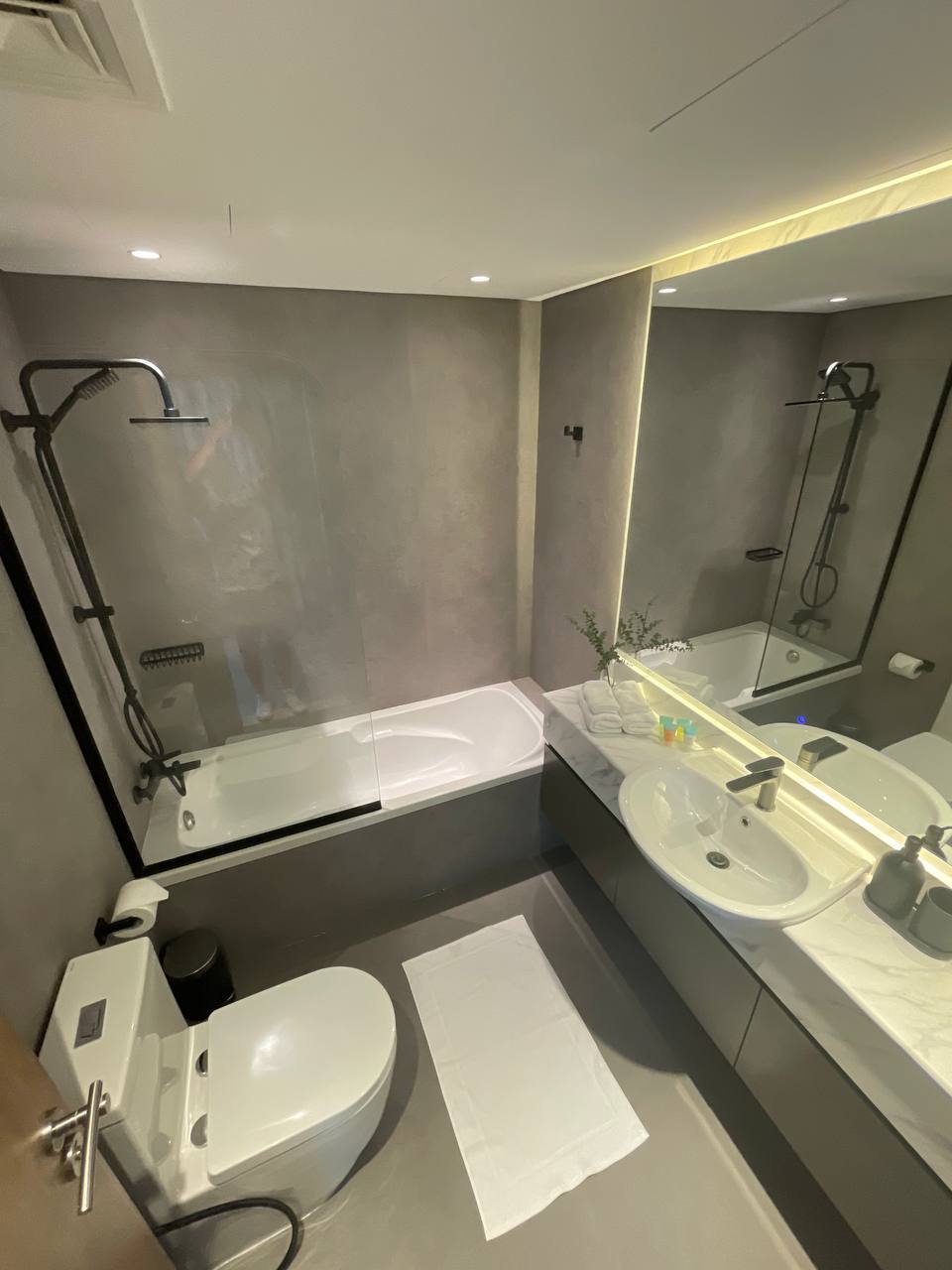
Wet area finishes in an extension: black fixtures on grey tile, sealed and tested before handover.
How long a villa extension takes in Dubai
Plan 4 to 10 weeks for approval and 10 to 16 weeks to build a single storey villa extension, so 4 to 6 months end to end for most projects.
Permit stage
- NOC application and community review: 1 to 3 weeks
- Drawing preparation and authority submission: 1 to 3 weeks
- Authority review, comments and permit issue: 2 to 4 weeks
Build stage
- Enabling works, demolition and excavation: 1 to 2 weeks
- Foundation, columns and slab: 3 to 5 weeks
- Blockwork, roof and waterproofing: 3 to 4 weeks
- MEP first fix, plaster and screed: 3 to 4 weeks
- Finishes, testing and snagging: 3 to 5 weeks
Rain in winter can add a week or two on excavation and waterproofing. Two additional weeks are common when the extension ties into an existing structure, because the old slab and columns have to be exposed and checked before they are loaded.
How to audit an extension quote line by line
A weak extension quote hides the same things every time, and every one of them becomes your cost later. Read the paper in front of you against this list.
- A single lump sum with no quantities and no rate per m2
- A structure rate that quietly excludes MEP
- Provisional sums on authority fees with no ceiling
- No line for the NOC deposit, which is refundable to you
- No demolition or debris removal line
- AC, ventilation and drainage left out of scope
- Tiles and sanitaryware marked client to supply, then charged again in variations
- A payment schedule front loaded with a 40 percent advance
- No programme, no inspection schedule, no completion certificate commitment
We read the quote you already hold, line by line, against the drawings and the community code. Where the scope is thin, we name the gap. Where the price is fair, we say so. Then we re-price the same villa work as a clear figure from AED 100,000. If you want that audit, send us the extension quote you already have on WhatsApp at +971 50 786 0555 and we will go through it with you.
Frequently asked questions
How much does a villa extension cost in Dubai?
Most ground floor extensions run between AED 2,800 and AED 4,200 per m2. A 60 m2 extension therefore sits at roughly AED 168,000 to AED 252,000, plus AED 8,000 to AED 30,000 in permit, NOC and inspection fees. First floor additions cost more per m2 because of lifting and propping.
Do I need a Dubai Municipality villa extension permit before starting work?
Yes. Any extension that adds built up area needs a Dubai Municipality villa extension permit, and in a managed community you also need the developer NOC before you submit. Starting early work without a permit risks fines and a demolition order, and it will block the completion certificate you need later.
How long does villa extension approval in Dubai take?
The permit route usually takes 4 to 10 weeks from NOC application to issued permit. Community NOC review is often the slowest part at 1 to 3 weeks, and authority comments can add one resubmission. Work that needs a DEWA load assessment can add another two weeks.
Can I build an extension without a developer NOC?
No, if your villa sits in a managed community. The master developer or community management reviews the design against the community design code and holds a refundable deposit until the build is complete. Building without the NOC usually triggers a stop work notice and a fine from the community as well as the authority.
Will a villa extension affect my DEWA connection or title deed?
Extension work itself does not change your title deed, but if you added habitable area you should update your records and the plot file. DEWA may need a load assessment for added AC or kitchen equipment, and an annex with its own entrance sometimes needs a separate meter installed.
Can I extend a villa up instead of out?
Yes, and it is often the better option when your plot ratio or setbacks are tight. A first floor addition over the existing footprint usually needs less excavation work but more structural strengthening, and it prices around AED 3,200 to AED 4,500 per m2.


