
Home → Articles → Villa Renovation Payment Schedule Dubai: A Fair Contract
Villa Renovation Payment Schedule Dubai: A Fair Contract
A fair villa renovation payment schedule in Dubai releases money against completed stages, not against calendar dates. Expect 10% to 15% on mobilization, larger payments tied to structure, MEP and finishes, and 5% to 10% held back until snagging is closed.
Share this article: WhatsApp | X | LinkedIn | Email
Why work with ROUND TRIANGLE DECORATION CO. L.L.C
- Line by line quote review before any price is given
- Villa renovation pricing from 100,000 AED
- Fixed written scope with a stage by stage payment schedule
- Payment milestones released against completed site work
- Retention held until snagging is closed out
- Direct WhatsApp line to the team on +971 50 786 0555
Why the payment schedule is where a weak quote hides
The payment schedule is where a weak quote hides because it decides how much risk you carry. Two contractors can quote the same 180,000 AED for the same villa, and the one asking for 40% upfront with no milestones is the weaker contract even when the total is identical.
Look at where the money sits. A single mobilization payment that already covers demolition, blockwork and MEP first fix means you have funded three stages before one of them is finished. No retention line means the last 5% leaves your account before the snag list is closed. Tiles, sanitaryware and AC units billed as extras after signature are not a fixed price at all, and those are exactly the villa renovation hidden costs that surface mid-project.
A quick test: count the payment stages. Fewer than four stages across a full villa renovation, or more than 40% requested before any structural work, tells you what the contract is built to protect.
A fair stage-by-stage villa renovation payment schedule in Dubai
A normal villa renovation payment schedule in Dubai runs on six to eight milestones, and each payment is released only after the previous stage is inspected and signed off. The bands below are the range we see on well drafted villa renovation contracts in the emirate.
| Stage | Payment band | Released when |
|---|---|---|
| Mobilization | 10% to 15% | Site protection, hoarding and demolition setup in place |
| Structure | 15% to 20% | Blockwork, openings and structural work inspected |
| MEP first fix | 15% to 20% | Electrical conduits, drainage and AC ducting signed off |
| Approvals | 5% | DET or Dubai Municipality permits and DEWA application submitted |
| Screed and wet areas | 10% to 15% | Waterproofing flood tested |
| Finishes | 20% to 25% | Tiling, joinery, kitchen and painting complete |
| Handover | 5% to 10% | Snag list closed and keys handed over |
How the release works on site:
- The contractor issues a stage completion notice with dated photos.
- You or your engineer walk the villa and check the stage against the BOQ line items.
- Both sides sign a stage certificate listing what was done and what was not.
- Payment is released within the agreed window, usually 7 working days.
- The next stage starts only after the previous one is signed, unless stages overlap by design.
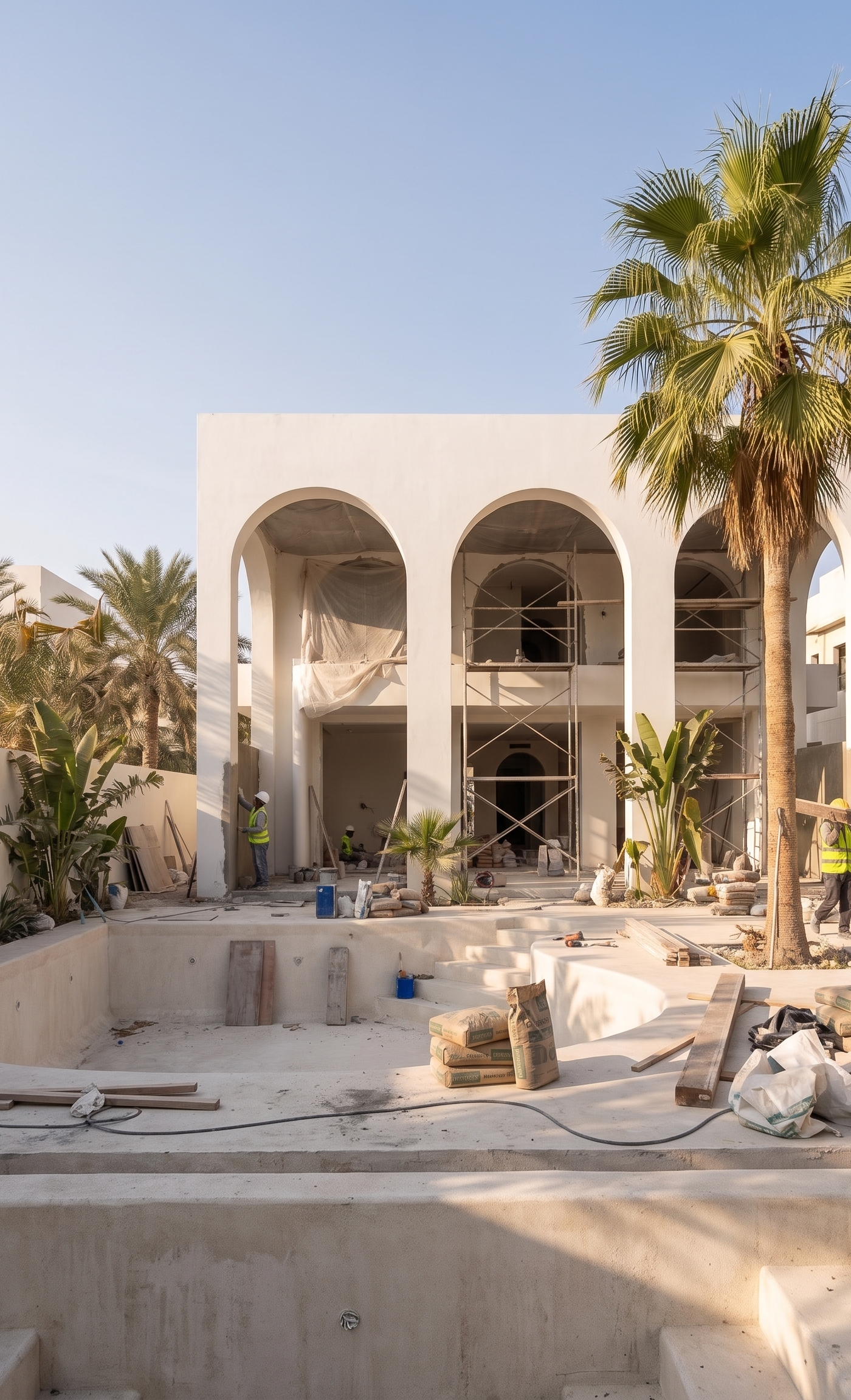 Structure and MEP first fix are usually where the largest single payment falls.
Deposit, advance payment and retention: what is normal in Dubai
A villa renovation deposit in Dubai normally sits between 10% and 20% of the contract value, and it should buy something specific rather than goodwill. Anything above 30% requested as a villa renovation advance payment before structural work starts is a red flag, whatever the wording.
Red flags to check before you sign:
- 30% to 40% upfront with no site milestones attached
- Cash only, with no company bank account and no receipt
- No retention clause anywhere in the villa renovation contract
- Payments tied to calendar dates instead of completed work
- Materials listed as separate payments outside the BOQ
- Approval fees, DEWA deposits and municipality charges left unpriced
- A deposit that grows the moment you ask for a written stage schedule
A deposit is not an advance. A deposit commits you to the contract and pays for site setup, protection and the first material order. An advance is money handed over before any work is measured, and it is the single biggest source of villa renovation disputes here. If you are already holding a quote and cannot tell which one you are looking at, get your villa renovation quote reviewed line by line before you pay anything.
Reading payment terms in the contract versus the BOQ
The BOQ says what is being built and the contract says when you pay for it, so the two documents have to match line by line. If the BOQ lists 42 items and the schedule has 3 stages, the stage descriptions should name which BOQ lines each payment covers.
Approvals as a milestone
DET or Dubai Municipality approval and the DEWA connection application should be named milestones with their own payment line, usually around 5%. When approval hides inside a general paperwork phrase, a delay of four to six weeks becomes your problem with no price attached.
Variation orders
Every variation should be priced in writing before the work starts, using the same unit rates as the original BOQ. Ask what markup applies. A 10% to 15% markup on a written variation is normal. A variation quoted after the work is already in the wall is not a price, it is a bill. It is also one of the criteria worth scoring when comparing villa renovation contractors in Dubai.
Paperwork you should hold
Ask for the trade licence, the contract on company letterhead, and payments into a company account. A stage certificate signed by both sides is your evidence if the schedule is ever disputed.
A 100,000 AED villa renovation payment schedule mapped by stage
For a four bedroom villa of the kind common in Al Barsha or Mirdif, a renovation budget usually lands between 100,000 AED and 350,000 AED, and the percentage split stays broadly the same at both ends. Here is how the money maps across stages.
| Stage | Entry villa at 100,000 AED | Full renovation at 350,000 AED |
|---|---|---|
| Mobilization 10% | 10,000 AED | 35,000 AED |
| Structure 15% | 15,000 AED | 52,500 AED |
| MEP first fix 20% | 20,000 AED | 70,000 AED |
| Approvals 5% | 5,000 AED | 17,500 AED |
| Screed and wet areas 10% | 10,000 AED | 35,000 AED |
| Finishes 30% | 30,000 AED | 105,000 AED |
| Retention 10% | 10,000 AED | 35,000 AED |
The lower the budget, the more the finishing share matters, because labour and materials are squeezed into the same 30%. A 350,000 AED budget buys imported sanitaryware, large format porcelain and a proper joinery package. A 100,000 AED renovation on the same schedule buys the same trades at a tighter specification. What should not change is the shape of the payments.
 Finishes usually carry the largest single payment because materials are ordered and installed in one push.
If you want the same villa work priced clearly from 100,000 AED, send us the villa renovation quote you already have.
Checklist: 6 questions to ask before signing
Before you sign any villa renovation contract in Dubai, ask these six questions and insist the answers appear in writing.
- What exactly does the mobilization payment buy, line by line?
- Is every payment tied to a completed stage or to a date?
- How much is retained, and how long after handover is it released?
- Are DET, Dubai Municipality and DEWA fees inside the price?
- How are variations priced, and at what unit rates?
- What happens to my payments if approvals take longer than the programme allows?
If a contractor cannot answer these in writing within a day, the payment terms are still being designed around their cash flow instead of your protection.
Frequently asked questions
What is a normal deposit for a villa renovation in Dubai?
Most villa renovations in Dubai start with a deposit of 10% to 20% of the contract value. On a 150,000 AED renovation that is 15,000 AED to 30,000 AED. A deposit above 30% before structural work begins is unusual and worth challenging in writing.
Can I pay for a villa renovation in Dubai in instalments?
Yes, and you should. A villa renovation is normally paid in six to eight instalments, one per stage, with the final 5% to 10% retained until snagging is closed. Instalments are released against signed stage certificates rather than a fixed monthly plan.
Should I pay for materials directly?
Usually no. Materials should sit inside the BOQ and inside the stage payments, so one party stays responsible for delays and defects. Paying suppliers yourself splits that responsibility and weakens your leverage if a delivery is wrong. The exception is a single imported item you want to buy yourself, and that should be written into the contract.
What if the contractor asks for cash?
Ask for the trade licence, a company bank account and a VAT compliant receipt, then pay by transfer or cheque. Cash with no receipt gives you no proof of payment if the schedule is disputed, and it rarely comes with a retention clause attached.
How does retention work on a villa renovation?
Retention is the final 5% to 10% of the contract that stays with you after handover. It covers snagging, paint touch ups, door alignment and any defect that shows up in the first weeks of use. Typical release is 30 to 60 days after handover, once the snag list is signed off.
Does the payment schedule change if approvals take longer?
The amount should not change, but the timing will. Approvals and the DEWA connection are usually a 5% milestone, so a four to six week delay moves that payment later instead of adding cost. What should be agreed in advance is who carries the delay and whether site overheads are charged while you wait.


